Friday, April 16, 2010

Three Pages of done ToDo List, One more to go


For those of you with an interest in such things, it looks like the cost of this year's Pacific Cup campaign is going to come in around $20,000. (We have spent roughly $12,000 so far according to the running total at the bottom of the ToDo List.)

An unexpected item was the new Garmin GPS and plotter unit that I decided to add because the (really old) Trimble GPS was getting hard to read. The new one is kinda cute and, much to my amazement, it seems to work below decks even without an antenna.

Another useful item is the wireless remote for the autopilot. Currently there are three separate controls. One is the base station at the Nav Station. The second is the wired remote at the wheel (that can be brought in under the dodger). The third is the wireless unit shown in the photo that lets me steer from my bunk. (And navigate as well, since the unit also relays GPS info just like the other units do.)

We turned the boat around in the slip to make it more convenient to work on the stern. Then we removed the wind-vane  rudder and replaced it with the (much larger) emergency rudder unit. The photos show the emergency rudder in the water and stowed up out of the way. To actually wait until the emergency rudder is needed and then try to install it in a seaway is probably more exciting than absolutely necessary.
Another item that has taken up a couple days of my time is the First Aid Kit. We have three main Kits. One is in the Grab Bag that goes with us if we need to abandon ship. It was getting a little "long in the tooth" after all these years, so I made up a fresh one. Of course, in the unlikely event that something is needed we can use it to supplement the other kits.  Another Kit is located in the head  compartment. It is pretty complete and is supplemented by extras, like cold packs, sunscreen, seasickness items, etc. The third kit is a big bag of all kinds of serious stuff. I spent a couple days on this and I have an Excel table listing everything if anyone is interested. One of the problems was the fact that many of the prescription drugs that this kit contained were hopelessly out of date. I got my Kaiser doctor to prescribe some new stuff, so I'm pretty happy with the current state of things.There are things like sutures for sewing up gaping wounds. Might be fun to try that should the occasion arise.

There is a sea bird here in Hawaii called a Kolea (Golden Plover)  that has a wonderful story. Most of the year they are very shy and their dull brownish uniform coloring lets them blend in. They are unusual in that they seem to benefit from civilization. They like to pick bugs from lawns, parks, golf courses, etc. Normally they are very solitary, and each one stakes out his own territory and chases other Kolea away. At this time of year a drastic transformation takes place in their coloring. Look at the photo. Isn't this guy a beauty!

There is also a change in personality. Instead of shy they become agressive. One of them that I disturbed recently thought about trying to chase me away. (But changed his mind.) Some time (very soon) they will start to gather in flocks and at some magic moment that only they can sense (There might be weather factors.) they spiral up into the sky and set out for Alaska (and maybe Siberia). When they get there (after recovering from the flight) they hustle up a mate and get down to the business of raising some chicks. 

When the chicks are getting big enough to fend for themselves (and the days are getting shorter) the adults head back to Hawaii.  Amazingly enough the chicks follow later after they bulk up on bugs and get some more flying practice. Then the cycle repeats. Quite a story.

While I clearly enjoy composing these blogs, it would be nice to get some feedback. If you are a reader please make an occasional comment (at the bottom of the page). When we are sailing the comments will come automatically to us by email and that way the blog can become more interactive.

Monday, April 12, 2010

This Time for Real

The ToDo List (to the right)has been updated.
 
How can it be almost two weeks since my last post? Seems like yesterday. Hard not to start getting a little tense. The way time flies.

Que Sera Sera. We will be ready when the time comes (or not).

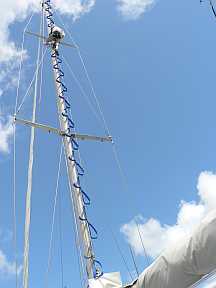
We are finally finished with the work up the mast (No April Fool this time.)  and there are some pictures here from the last trip up. That's it for awhile I hope. I needed to lubricate some blocks and add some safety wiring.

We also lubricated the turnbuckles on the shrouds so they will not be so hard to adjust. (I'll probably be tuning the rig this afternoon or tomorrow morning.) A major set back on the schedule (and budget) was the need to remove the sail and take it to the sail maker to fix 10 holes that got punched into the mainsail when I dropped a sharp object from the top of the mast. (Actually, this was not my proudest moment.)

One of these photos is Cirrus from above. Isn't she pretty?

Another recent project was the addition of a new Garmin 440 GPS-Plotter to supplement the Trimble system (whose screen is starting to cloud up). Much to our amazement it seems to be working fine below decks at the nav station without an external antenna. We will check it out when we get sailing again. SOON!

I'll try backing the boat into the slip the next time we go out so it will be easier to install and test the emergency rudder system. It is the same system as in previous years so we don't expect any problems.

The last of today's photos shows the replacement U-bolt for the starboard, spinnaker halyard block. The U-bolts went in without a hitch. Moo did a good job. The old ones lasted 37 years so these ought to do the job for awhile. (Of course a lot of the actual usage was more recent.)

That's it for today's blog. We should be sailing again in a couple days and that will be more fun than all these projects. I'll keep you posted.

Friday, April 2, 2010

Keeping, keeping at It.

In spite of the optimistic email that I sent to all of the crew yesterday (April 1st,2010) declaring that all of the work had been done, there is actually a long way to go.

The U bolt photo at left is a good example. I've two new ones but do not want to go to the top of the mast until the shrouds are back on. The mounting brackets for the spreaders are back on the mast and the tangs for the running backs and lower diagonals as well. (Four or five hours up the mast yesterday in 30 knot winds. (No April fool.) But I could not pull the cables up to get the pins in. Working on it.

I ended up removing the turnbuckles completely to put more slack in the wires. (I hope you are as fascinated as I am by these minutiae.) And I think I'll take them to Moo to see if the somewhat corroded threads can be cleaned up so they will be easier to use. (Not a given since left-handed metric threads are involved.) Actually, I think I'll do it myself. All it takes is time.

Up the mast again this morning with Ron Dodini, a friend from KYC, handling the safety line and hauling tools up and down on the spare jib halyard (an hour or two in 25 knots and rain) and I got the lower diagonals in finally. (Weather sucks.) There was a solid black wall of wind and rain coming across the bay so I bailed out. The running backs can wait until tomorrow.

Another thing I'm going to do tomorrow is replace the VHF antenna on the top of the mast. Hope that helps the performance. I hooked the antenna up directly to the radio for a test, and learned something interesting. It did not seem to be working even though the tester was giving it high marks. Then by accident I discovered that the performance depends very sensitively on the antenna orientation. Very, very sensitive to the direction it is aimed. (If you want to know if a "high gain' antenna is better (or not) contact me.)

It is sort of hard to see but Ric recently replaced 2nd anchor (lunch hook) with a new anchor, new 30 ft chain and 200 ft of brand new nylon rode.
this arrangement is a little better than the race requirements call for. The primary anchor at 48 lb and with 200 ft of chain is way better than required.

The next item is the Spray Curtain just inside the hatch that protects the electronics from the  spray generated by the "rooster tail"  thrown up by the boat as the downwind speed exceeds normal limits. The bolt rope on the top edge was getting ratty so it has been replaced. It needs to be cleaned.


Each crew member gets a shelf for their personal gear. That is mainly stuff like clothes, books, video games, exercise DVDs, handheld GPS (In case Navigator get's lost.), etc. There is some space for toilet gear in the head and foul weather gear goes into the hanging locker behind the head. Some people try to sneak in their own private supply of chocolate or other goodies but this is officially frowned upon.

Some more PFD testing took place. There are 5 on the boat that are up to date and would pass inspection. One is mine and Ric is using one (that Tina could use if she wants to), the other three are spares. Other crew could use them if they do not have their own. I kind of like to have my own. There are spare parts for all of them.

Wednesday, March 31, 2010

No Mast Today

Not going up the mast today. Gusts to 50 predicted.

But that was not really the problem. I was still waiting for parts. Finally, after a couple hours messing around (partly with bringing PFDs up to date) I decided to head for Maupunapuna and Hawaii Nut and Bolt to pick up some hardware that I was going to need. Nylock nuts, stainless cotter pins, etc. And, as I had hoped, I got a call, while I was there, telling me that the fabrication and repair work was done. (Photo tomorrow.)

Boy, talk about Murphy's Law. I had just bought new stainless Nylock nuts for the U bolts that were being fabricated. Just for fun I tried out the new nuts while sitting in the parking lot at Moo's Machine Works. They almost fit but not quite. Moo (himself) was strolling by and asked me if there was a problem. I showed him what was bothering me. With a big smile he explained that, as a special favor to me, he had cut Imperial threads rather than metric. That way, he explained, the nuts I needed would be easier to find and less expensive. What a great guy!

I might have discovered the problem back at the boat or worse up the mast. Any way, back to Hawaii Nut & Bolt to swap the four nuts for ones with English threads. (Actually, Moo was right, the new nuts were $14 cheaper than the metric ones.)

Back at the harbor waves were breaking against the breakwater and there was spray in the air everywhere. Down below it was nice and cozy. So, I found inside stuff to do. You could almost ignore the wind except that every 5 minutes or so a gust would jerk the boat and I'd have to grab something to keep my balance.

That's it for today. Hope to start putting things back together tomorrow. Depends on the weather.

Sunday, March 28, 2010

Sunday, March 28th, 2010

Makes me sad to see the boat sitting at the dock week after week, but there are so many things to do getting ready for the delivery and race that get in the way. Fortunately Ric & Marie Lucia, Caroline, my slip neighbor Tom  and Ann (with friends) showed up last weekend in one of those rare windows of opportunity between working on the motor and working on the mast. We had a great day out in the ocean. Now it is back to the old grind.

OK. This is a quiz. How many of you know what the next photo is. Right! It is an inflated PFD (Personal Flotation Device) being tested to make sure that it doesn't leak. Normally you blow into the fill tube (visible in the photo) to inflate the device for this test but we had an old CO2 cartridge so we (Ric and I) decided to pull the cord and let it blow itself up. It worked fine.

Then with another old cartridge and an old automatic release pill we decided to pour some water on it to see if the automatic inflation would still work. It worked fine again. In fact it even worked a third time when I made a mistake assembling the unit and accidentally set off a good new cartridge. In the photo note the strobe light and whistle fastened to the inflation tube. This PFD also carries two small rocket flares and a signal mirror. It has a couple stripes of reflecting tape and the name of the owner and the name of the boat are written on it. Most of these details are necessary to meet the requirements of the OSR (as quoted below).


5.01Lifejacket
5.01.1Each crew member shall have a lifejacket as follows:-
     
a)equipped with a whistle
     
b)fitted with marine grade retro-reflective material (OSR 4.18)
     
c)compatible with the wearer's safety harness
     
d)if inflatable, regularly checked for air retention
     
e)clearly marked with the yacht's or wearer's name
5.01.2A lifejacket shall have:
     
a)at least 150N buoyancy, arranged to securely suspend an unconscious man face upwards at approximately 45 degrees to the water surface - in accordance with ISO 12402 - 3 (level 150) or equivalent (for persons of larger than average build the ISO 12402 – 2 (level 275) jacket should be considered);
     
b)a crotch strap or thigh straps;
     US SAILING prescribes that OSR 5.01.2 b) shall not apply but recommends that lifejackets have a crotch strap or thigh straps.
     
c)a lifejacket light in accordance with SOLAS LSA code 2.2.3 (white, >0.75 candelas, >8 hours);
     
d)if inflatable have a compressed gas inflation system.
     It is strongly recommended that a lifejacket has:
     
e)a splashguard/sprayhood See ISO 12402 - 8;
     
f)A PLB unit (as with other types of EPIRB, should be properly registered with the appropriate authority)
     US SAILING prescribes that for Categories 0, 1, 2, 3 either a Type 1 U.S. Coast Guard approved floatation device or an inflatable personal floatation device meeting the definition in the above paragraph and manufactured to either British national or European Community standards. A light should be fitted and a crotch strap is recommended on each lifejacket. Each inflatable device should be inflated and inspected annually. Service dates shall be marked on the floatation devices. This inflatable device may be integrated with a safety harness (see OSR 5.02).
     US SAILING prescribes that all personnel on deck shall wear personal floatation while starting and finishing without exception, and at all other times except when the Captain of the boat directs that it may be set aside.
     US SAILING note: As is true of all of these regulations, the prescriptions above do not necessarily replace the requirements of other governing authorities.


One of the things keeping us from sailing is the need to clear up the "Recommendations" that the (previously mentioned) surveyor made. One of those Recommendations concerned the Mast Step that needed to be "cleaned up, painted and preserved". As you can see from the photo this area of the boat is now beautiful and shiny. You could do surgery here. Well, maybe that is an exaggeration, but it sure looks a lot better.


It turns out that the really big projects are up the mast. The webbing ladder is a really big help. Some boat workers go up and down masts with a simple "bos'n" chair. I have never been happy with that  arrangement (above the first spreader). For some people the ladder is enough. I like to have someone tending a safety line as well. It is a long way down.


The two worn U bolts at the masthead were tough to remove but a special BH tool finally did the job. There is no standard place to buy things like this so new ones will have to be fabricated. "Moo's Machine Shop" They will probably cost less than if they were made of gold.


Now I'm working on the upper spreader brackets. It turns out that (evil design) they can't be removed like you would expect with the removal of 8 pop rivets. Nope! Their removal requires the removal of the running back stays, the lower diagonal shrouds, the mounting plates for the shrouds and the compression sleeve bolt assembly inside the mast that normally holds the mounting brackets. Ridiculous!!!!

Monday, March 22, 2010

Fashion Show

The latest on what cutting edge fashions this year's Pacific Cup sailor will be wearing.

Actually, this photo essay covers only the heavy duty stuff that the delivery crew will need for at least the last half of the trip, and the racing crew will need for the first 4-5 days. Anytime you are sailing in the ocean anywhere in the vicinity of San Francisco it is going to be COLD.

A good place to start is the beginning. Check out the polypropylene long johns. You will be so happy you have these (maybe bring a couple pair). Then there are the shorts and tee shirts.

I often just wear the longjohns, shorts and boots when I am below and out of the weather. As it starts to warm up (during the race) the tee shirts get rationed out so they last until the end of the race. That reminds me; it is good to have a laundry bag that is odor tight.

Next are the shoes and boots. A leaky old boot could spoil the whole trip. In addition good boat shoes  are important. Maybe two pair. Note the sequence: cotton liner socks, wool over that (poly might be better) then Gortex socks (from REI) and then the boots. Warm feet are a blessing.

Gloves and hats are next. One (or two) really good hats against the cold and one hat against the sun. Then as many gloves as you can afford. Remember, all night long it is often squally. That means that you are going to get wet again and again. Usually things don't dry down inside the boat, so if it is wet it will probably stay wet. Sometimes toward the end of the race there will be nice sunny says where things will dry out outside (and blow away) but don't count on it. Kneepads are also a good idea for those occasions when we we get into serious race mode.

The next layer is fleece. This particular pair have probably crossed the Pacific Ocean sixteen times. One pair is probably enough. Or two if you have space.

That means that this is a pretty good spot to pause and talk about space. Each person has a little more than a cubic foot of space for clothing and personal effects. This has proven adequate in the past. There is also a hanging locker (and other space) in the forward compartment for foul weather gear, PFDs, tethers and boots. There is also space for toilet kits above the (non-functioning) sink opposite the head. If you absolutely must sneak a chocolate bar (or the like) aboard, then do it. But, generally speaking people are discouraged from bringing food aboard. If you want to have something special, let us know and we'll get it.

Back to the subject at hand. Marine Fashion.

This is a "Coastal" jacket. It would do the job, but it is not very long in the waist (and there is no drawstring) so something heavier is preferred. On the fore deck, for example, when the boat is occasionally putting its bow under. So, if you have something like the "Offshore" jacket shown in the next photo, then bring it along as well.

Finally, it is time to pull it all together and make a true fashion statement. Our model has kindly agreed to don the whole outfit (in spite of the blazing sun and balmy Hawaiian weather). So this is the final product. Note the brilliant lime green of the hood and the shiny patches of reflecting tape (Required by the OSR, Section 5.)


This is probably a good place to remind all crew members of their personal responsibility to be acquainted (and comply) with the Notice of Race  the Offshore Special Regulations. These both appear on the Pacific Cup website. These documents are detailed and confusing. So, if you have questions now is the time to ask.

Friday, March 19, 2010

The Survey is Behind Us


The Insurance Survey went pretty smoothly. The same surveyor as 4 years ago, so the long winded recitation of the boats condition and equipment is nearly identical. The surveyor checked the usual suspects but really wanted to see how well we had fixed the discrepancies he found the last time. I think we passed that one with flying colors.

Even some of the problems noted are similar (not identical) to ones from before. The biggest pain is probably going to be some repair work on the mast boots for the upper spreaders. (The stainless steel bracket that holds the mast end of the spreader in the correct position.) They will have to be removed and repaired (or replaced) and that means letting the spreaders slack and probably half a dozen trips up the mast. The repairs (or fabrication) will have to be done in a professional metalwork shop. ( All it takes is Money and Time.)

There are a couple other problems up the mast but I'm going to get depressed if I continue along this line, so enough! There aren't really any pressing problems so I'm going sailing Sunday. Blow the dust off the boat.

Wednesday, March 17, 2010

Round the Bend

The day started out pretty much as usual with a lot of overcast and blustery conditions. This time, instead of rain, we had mist, fog, vog, whatever. Anywhere you looked the view just faded into grey.

I have been leaving the main hatch (under the doger) completely open when I'm away from the boat and there is a fan running below. The intention is to blow out some of the stink. It seems to be working.

In fact, miracle of miracles, I spent most of today cleaning the boat rather than making it dirty. (Which is the essence of what we have been doing most days for the last month or so.) It doesn't feel right to not be making a mess. I also didn't break anything, or injure myself in any way. An altogether fine day. Even changed the engine oil and washed the dirty dishes.

In case you are starting to get worried that I will run out of things to do, and start getting into (idle hands) trouble, you can console yourself with the fact that an Insurance Survey is scheduled for Friday. Surveyors have a code of conduct that requires them to find fault or risk being shunned by their colleagues. So, the results of the survey will probably keep us busy for awhile.

I also ran a SWR check (That's Standing Wave Ratio for the nerds in the audience.) on the VHF radio. It failed. Probably needs a new antenna. Also, it looks like the screen on the GPS is failing. Probably time for a new one. (Now there is a  project: providing power, mounting, connection to autopilot and computer, mounting antenna, etc.)

Oh yes. A glance at the latest update of the ToDo List confirms that there is no real danger of running out of things to do.

Tuesday, March 16, 2010

Monday Morning (says it all)

As is often the case there was a bit of drama in the sky over Kaneohe Bay just before dawn. The cloud in the photo exploded into existence and was gone in a matter of minutes.

The main task for the day was to (endlich) finish installing the new wiring harness on the engine and connecting it up to the new engine panel. I actually managed to get that done (in fits and starts) before the day was done. The problems were nothing special, just the well known domino effect.

At one point I found a wire that wasn't connected to anything. So, I decided to trace it back. That was going to be impossible without removing it. So,what the heck, I decided to remove it. After spending the next hour or so in many dirty, awkward and uncomfortable positions I finally located the other end of the wire. It was connected to an unlabeled switch which was protected by a fuse that had been removed.

In the course of pursuing this odyssey I uncovered one of the battery banks and discovered that the water level in the batteries was low. So, of course, I interrupted the wire pulling that had interrupted the engine rewiring to fill the batteries. That project, in turn, had to be interrupted to go and buy some distilled water because the onboard supply had slipped away.

Which brings us to the next photo. Here you see the reason that I had to make a trip to the store for distilled water. The bottle of water that I had stored on the boat for just such an event had disintegrated. Simply died of old age. So, be cautious if you have water set aside somewhere for emergencies. When you need to use you might be in for a nasty surprise. At least, on the boat, the leaking water didn't do any damage. It just ran into the bilge and was pumped overboard.

Somewhere along the way all these projects got finished and the boat doctor's attention turned to the bow running lights that were not functioning. It was back to the Sherlock Holmes approach with volt meter in hand but some pretty awkward places to work up in the bow. Without Ric's help I had to go back and forth between the control panel at the nav station and the bow about a dozen times. (Not really suitable activity for someone who ought to be in an old folk's home playing checkers.) Some of the wiring was left over from when the boat was built and it runs inside a tube in the fiberglass that is not accessible. I have a couple spare breakers on an auxiliary power panel by the sink in the forward compartment, so, when I got fed up with fooling around with the meters and old wires, I just rewired the light from scratch. And that takes care of that.

As an aside let me mention that I hit my head pretty seriously on a metal fitting on the overhead in the extreme forward bow compartment. It hurt, but I tried to ignore it because I was busy and had my hands full at the time. Then I forgot about it. It wasn't until much later in the day (after getting someone to help me put up the mast ladder, after talking to a couple other boat owners, after doing some shopping on the way home) that I finally saw myself in the bathroom mirror at home. There was a gash across my forehead and dried blood running down my cheek that I had been unaware of.  I might have been arrested for frightening children (and small animals).

Sunday, March 14, 2010

The Story of My Life

Some problem arises (In this case -- with the boat race prep.) and a campaign is mounted to address it. Which quickly gets out of hand, and is followed by:

  • Major effort
  • Major time commitment
  • Major expense
  • Stress
  • Frustration
  • Concern
This is followed by resolution, where the casual observer might be inclined to remark that, "It looks pretty much like it did before you started."

A case in point is the propane delivery system for the stove already discussed in a previous blog. Initially, it seemed to be ok, but a crimp on one of the hoses was rusty so we (Ric and I) decided to replace  it. Since we also wanted to clean the cockpit locker where the tank is stowed we pulled the tank and took it to be topped off. While the tank was out we cleaned the storage space, replaced the rusted hose and put a couple layers of zinc anti-rust paint on the pressure regulator mounting brackets and the tie down hooks.

Finally, Saturday morning just after dawn on Kaneohe Bay, with all the pieces back in place, (And the stove re-mounted, after a complete re-building of the gimbal system.) it was time to just turn it on to be sure everything was working. (Did I mention the broken handle on the breaker switch that powers the propane regulator solenoid valve? That had also been replaced. So, we were good to go!) Well, you probably could see this coming. It didn't work.


The entire morning was spent tracing and solving the problem. First it was necessary to determine that the switch was getting voltage and that it was passing it on when closed. The next step was to check for current in the activated circuit. None. (By the way, I recently popped for a pricey clamp-on ammeter. (So cool. Exactly the right tool for the job.)  The next hour or so was occupied by slowly cutting the wiring apart looking for the problem and a minimally invasive resolution. (Short of simply replacing everything.)  Some time was spent with the expression E = IR, where E = 13, R = 12 and I = 0. In the course of this investigation a spare battery was used to successfully exercise the solenoid. Then the solenoid was activated using a spare set of wires that just happened to be laying around. Finally, in the face of overwhelming evidence, it was time to begin surgery on the installed wiring. The picture tells the story.

Even though the crimp on butt fitting was inside the shrink on rubber tube it had corroded in such a way that it would pass on voltage but not current. By the way, this is the second time I have seen this in the last couple weeks. It seems obvious now, but the shrink tubing is not effective in sealing two parallel wires. The little space between the wires leaks.

The offending joint was replaced with a properly insulated one and now everything works like a charm. And, you guessed it, the whole installation looks (and functions) pretty much like it did before we started.


Friday, March 12, 2010

New Crew Resume - Kathy McGraw


1985:  Learned to sail on Lake Merritt, joined Cal Sailing Club.

1986:  Took sailing/cruising course in Greece.

1986-1995:  Continued sailing/racing with the Cal Sailing Club and out of the Berkeley Yacht Club—lots of Vallejo races, Three Bridge Fiasco’s, etc.  Took various classes—Coast Guard Boating class, CPR, North U Racing tactics. 

1995 to 1998:  Spent three years in Palau, Micronesia.  Owned “I’Batku” (26 foot AMF Paceship).    

1997/1998:  Commodore of the Royal Belau Yacht Club.  Organized sailing camp for kids.    

1998:  Returned to the Bay Area and sailing/racing the Bay. 

2002-2008:  Volunteered with the Pacific Cup organization for the 2002, 2004, 2006, and
2008 races. 

2003—2006:  Served on the Board of Directors of the Berkeley Yacht Club.

2006:  Crewed on “Vanessa,” (Beneteau 57), in the Pac Cup.

2006—2008:  Served as Secretary of the Pac Cup Board.  Crewed on “No Ka Oi” (Gibsea 43) during the Drake’s Bay race.  Helped deliver “No Ka Oi” after the Pac Cup from Kaneohe to Ko Olina.

2009:  Crewed on “Inspired Environments” (Beneteau 40.7) for the the Midwinter races and the crewed Farallones race.  Crewed on “Final Approach” (Lidgard 60) for the Windjammers (Santa Cruz) race, and “Sorcery” (82 foot maxi) for the Half Moon Bay race.

Ongoing:  Crew on “London Calling,” (Santana 22), for Berkeley Yacht Club Chowders and Friday night races. 


Wednesday, March 10, 2010

cold, Cold, COld, COLd, COLD


I can't believe how cold and windy it has been here. I think there was even one day where the temperature never got over 70. Dark low clouds and gusty, squally patches of rain. Sure will be glad to see summer. On the other hand, I was not able to get much sympathy from Donna (at US Sailing) who looked out her window and reported 40 deg. (and snowing).

Since the engine work has been completed we've moved on to the galley and the stove and propane system. Ric has topped off the propane and replaced the hose from the tank to the regulator. (A second complete regulator and hose assembly is in the spares.) The propane locker needed to be cleaned and some of the fittings were badly rusted, so they were cleaned up and given a coat of zinc paint. Now it's beautiful and ready to go. The stove maintenance is a bigger project. In the past the stove sometimes would jam when it would swing on its gimbals. Because of its weight and the tight fit it was really hard to get it out so we could work on it. I'm servicing the aluminum mounting flanges and I used a router to remove some of the wood trim where it was sticking. I hope that solves the problem.

A little "sticker shock" yesterday when I dropped about a "boat buck" at Liferaft & Marine Safety Equipment Inc. For that I got a re-certified MoM, some new flares and two new fire extinguishers with (much) better brackets.